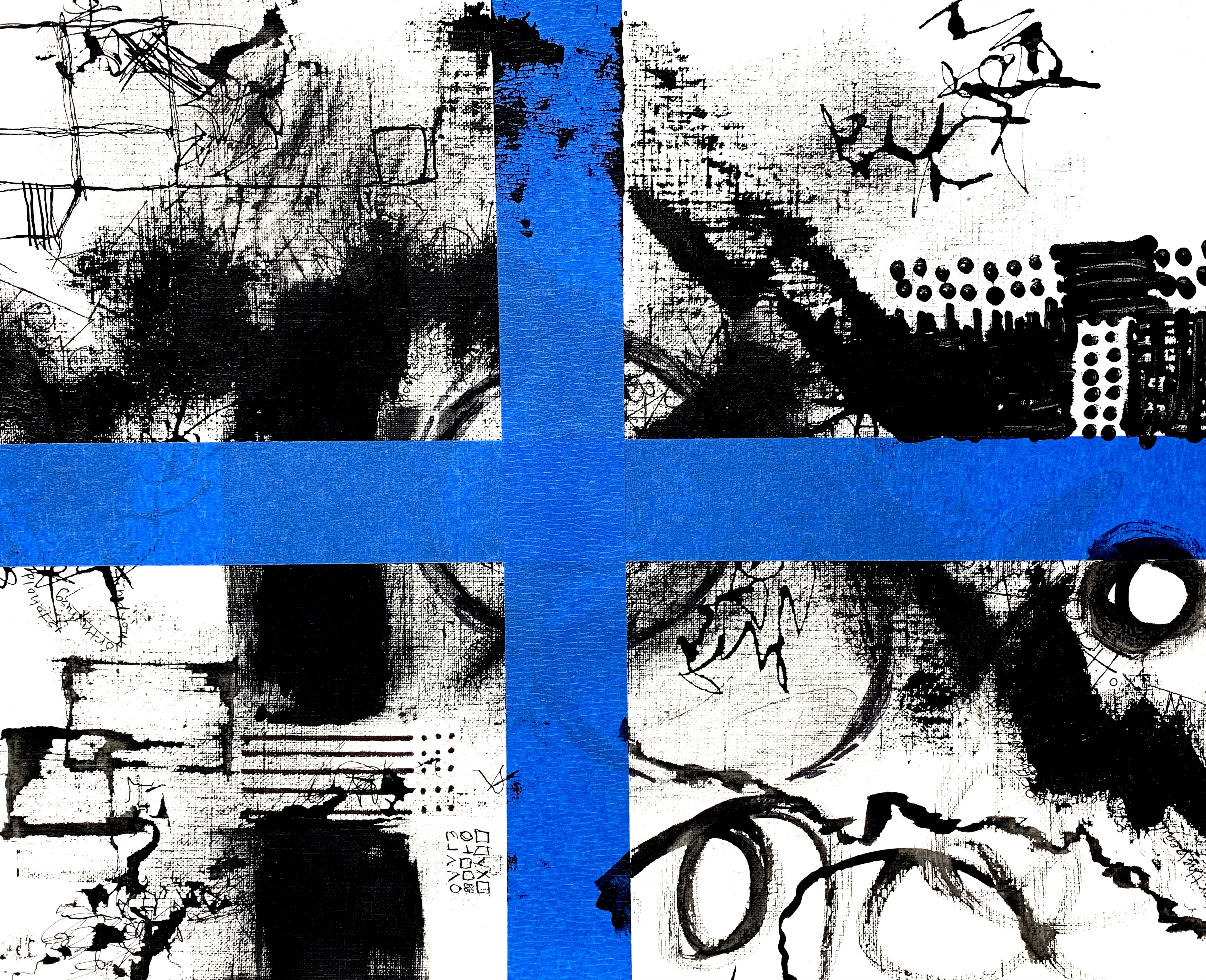
Three weeks ago on Hallowe'en, I started marking up a sheet of white canvas paper with black line work. Got attached, couldn't move forward in the moment, set the page aside.
![]() |
work in progress |
Three weeks ago on Hallowe'en, I started marking up a sheet of white canvas paper with black line work. Got attached, couldn't move forward in the moment, set the page aside.
![]() |
work in progress |
I build up b&w #1 with linework and more linework—fat lines, delicate lines, and middle weight lines; sharp edges and rough edges; straight lines, curved lines, lyrical lines, and neurographic lines; using paint, ink, graphite crayon, markers, brushes, dip pen, and my fingers.
Then I let this exploration sit, not wanting to let go of one bit of it. Every single line is precious!!
b&w #1 at the height of its original additions |
Today I finally return to subtract. Mystifyingly difficult for me but I like where I land.
b&w #1, after subtractions |
From No Happy Endings by Nora McInerny:
The first rule of improv is YES.
Well, YES, AND …
the AND is important.
YES is acceptance and acknowledgment
of the reality you've been handed.
AND is where the good part happens.
The good part is a conjunction?
You bet it is.
Because AND is about possibility and opportunity.
AND includes WHAT IS
and makes room for WHAT COULD BE.
AND doesn't require you to love the situation,
or to like the situation;
it just requires you to live.
Nora McInerny's book is entitled No Happy Endings, but, just as I finished quoting her above, I bumped into Orson Wells who says:
If you want a happy ending,
that depends,
of course,
on where you stop your story.
So, I said YES to b&w exercise #3, accepting and acknowledging the line work that had brought it to this point:
![]() |
Simone Nijboer's newsletter this morning fires me up to use India ink and a dip pen. The unpredictability of that kind of pen calls out to me as does the spontaneity and freedom with which Simone paints.
So, I pop into my studio on this gloriously sunny and deliciously warm November afternoon with windows wide open, insert a nib into a wooden holder, open a bottle of India ink, and add line work to one of my b&w exercises.
I also poke around Wikipedia:
• Basic India ink is composed of a variety of fine soot, known as lampblack, combined with water to form a liquid. No binder material is necessary: the carbon molecules are in colloidal suspension and form a waterproof layer after drying.
• Woods and Woods (2000) state that the process of making India ink was known in China as early as the middle of the 3rd millennium BC, in Neolithic China, whereas Needham (1985) states that inkmaking commenced perhaps as early as 3 millennia ago in China. India ink was first invented in China, but the English term India(n) ink was coined due to their later trade with India.